
Sencha and matcha are both Japanese green teas, and both come from the same plant, Camellia sinensis. But they are grown differently, made differently and drunk differently. If you have ever wondered why one is a loose leaf you steep and the other is a bright green powder you whisk, this simple guide explains the difference.
The short answer
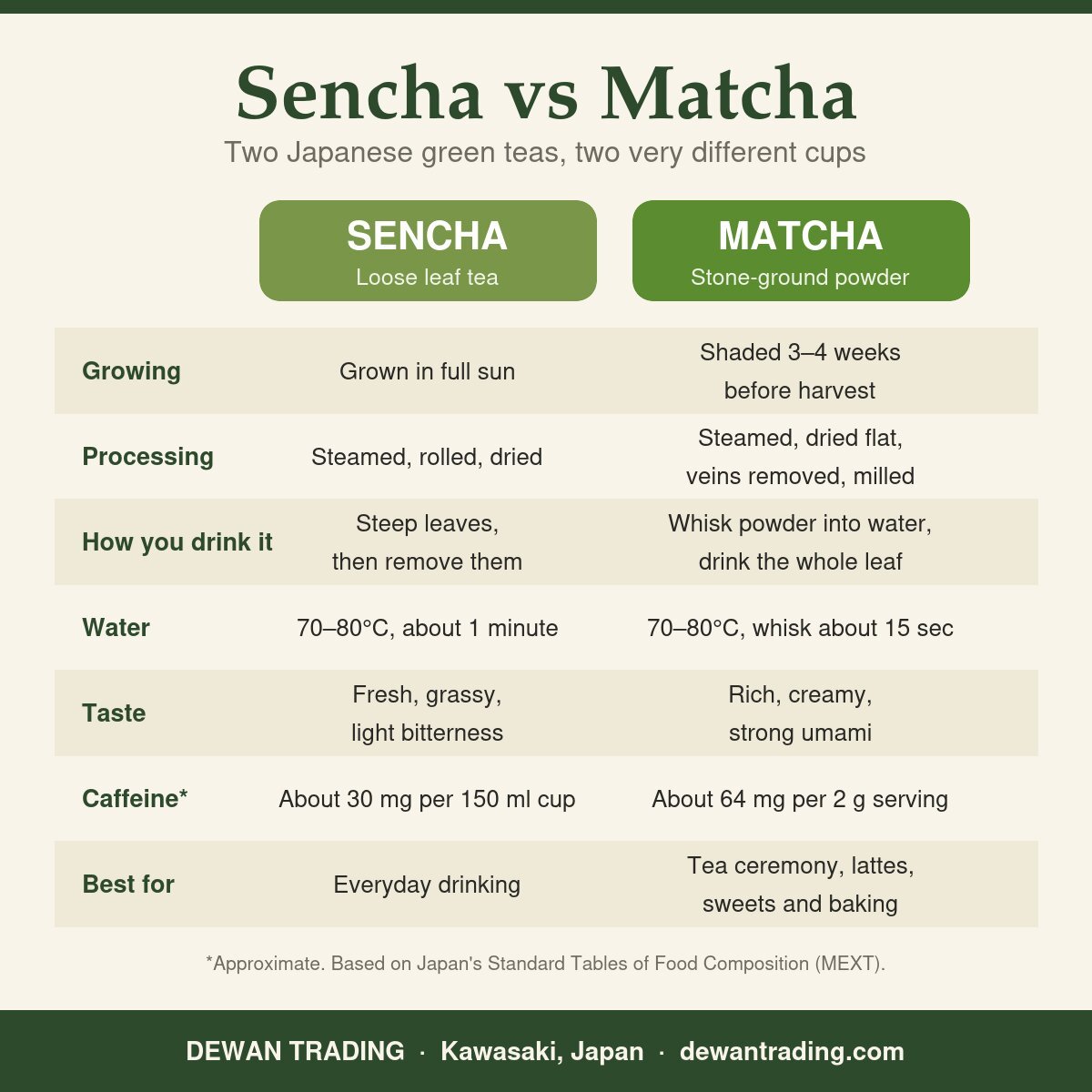
Sencha is a loose leaf tea. You steep the leaves in hot water, then remove them and drink the infusion. Matcha is a fine powder made by grinding special shade-grown leaves. You whisk the powder into water and drink the whole leaf. That one difference changes the taste, the caffeine, the price and how each tea is used.
| Sencha | Matcha | |
|---|---|---|
| Form | Rolled loose leaves | Stone-ground powder |
| Growing | Usually grown in full sun | Shaded for about 3–4 weeks before harvest |
| How you drink it | Steep, then remove the leaves | Whisk into water and drink everything |
| Taste | Fresh, grassy, light bitterness | Rich, creamy, strong umami |
| Caffeine | About 30 mg per 150 ml cup | About 64 mg per 2 g serving |
| Price | Lower | Higher |
| Best for | Everyday drinking | Tea ceremony, lattes, sweets and baking |
1. How they are grown
Most sencha is grown in open sunlight. Sunlight helps the leaf produce catechins, which give sencha its fresh, slightly bitter taste.
The leaves used for matcha are covered with shade cloth or straw for about three to four weeks before picking. With less sunlight, the plant keeps more of its amino acids, especially L-theanine. This is why good matcha is sweet, savoury and deep green rather than bitter.
2. How they are made
Sencha: fresh leaves are steamed to stop them oxidising, then rolled into thin needles and dried. The rolling is what lets the leaves open up again in your teapot.
Matcha: the shaded leaves are steamed and dried flat without rolling. This dried leaf is called tencha (碾茶). The stems and veins are removed, and the soft leaf is slowly ground into a fine powder, traditionally with granite stone mills. Grinding is slow work, which is one reason matcha costs more.
3. How to prepare them
Sencha: use 3–4 g of leaves per cup, water at 70–80°C, and steep for about one minute. Good leaves can be brewed two or three times. Our full method is here: How to Brew Japanese Sencha: A Simple 5-Step Guide.
Matcha: sift about 2 g (one heaped bamboo scoop, or half a teaspoon) into a bowl. Add around 70 ml of water at 70–80°C and whisk quickly in a zigzag “M” or “W” motion for about 15 seconds, until a fine foam forms. A bamboo whisk (chasen) works best.
4. Taste
Sencha tastes light, fresh and grassy, with a gentle bitterness and a clean finish. Matcha is thicker and richer, with a creamy texture and strong umami. Low-quality matcha can taste flat or harsh, so quality matters more with matcha than with most teas.
5. Caffeine
Because you drink the whole leaf, matcha usually gives you more caffeine per serving. Japan’s official Standard Tables of Food Composition list brewed sencha at about 20 mg of caffeine per 100 ml, so a 150 ml cup has roughly 30 mg. Matcha powder is listed at about 3.2 g per 100 g, so a 2 g serving has roughly 64 mg. Real amounts vary with the tea and how you prepare it.
6. Price
Matcha costs more than sencha for three main reasons: the extra work of shading the tea fields, the removal of stems and veins, and the slow grinding. Within each tea, price also depends on the harvest (first-flush spring tea is the most valued), the growing region and the grade.
Which one should you choose?
- Choose sencha if you want an easy, affordable green tea to drink every day.
- Choose matcha if you want a rich, energising tea, or an ingredient for lattes, sweets and baking.
- Try both. Many people in Japan drink sencha daily and enjoy matcha on special occasions.
Buying sencha or matcha in bulk?
If you are buying for a shop, café or distributor, a few points help you compare suppliers fairly:
- “Ceremonial” and “culinary” are marketing words, not official Japanese grades. Ask the supplier for the growing region, harvest season and intended use instead.
- Check the colour. Good matcha is bright, vivid green. A dull yellow or brown colour usually means lower quality or old stock.
- Ask for samples before placing a large order, and compare them side by side.
- Check import rules in your country, including pesticide residue limits and labelling requirements, before the tea is shipped.
- Look at packaging and storage. Green tea, and matcha especially, loses colour and flavour with heat, light and air. Sealed, light-proof packs and cool storage protect quality.
Dewan Trading is preparing to export Japanese sencha and matcha from Japan to buyers in Bangladesh, Saudi Arabia, the UAE and other markets. If you are an importer, distributor, café or shop interested in Japanese green tea, we would be happy to hear from you. Contact us here.
Akbar Dewan
Founder, Dewan Trading
Kawasaki, Kanagawa, Japan